The year, Route 66 enthusiasts celebrate the centennial of the historic highway of lore. Established in November 1926, the 2448-mile roadway paved the way for both commerce and adventure that captured America’s imagination.
Demographic forces and a need for speed led to Interstate freeways that eclipsed the onetime major transport artery that pulsed through the nation’s heartland connecting Chicago to Los Angeles. Though decommissioned 40 years ago, the old road remains embedded in our consciousness.
The early roadsters who traversed Route 66 and the organic businesses that grew up along the roadway to serve them engendered a uniquely American history. Fate’s lending hand bestowed the highway with a magical number, timeless song and maternal moniker that imbued it with legendary status.
Something intangible now draws adventurous roadsters to the phantom highway despite its omission from standard road maps. They venture forward to a bygone time for a slow two-lane ride to imbibe a true taste of Americana and a closeup view of our diverse geography. Indeed, old Route 66 still proves both instructive and an enjoyable drive.
Roots of a Route’s Legendary Status.
In 1926, the National Highway Association systematically organized and expanded our roadways in what would prove to be a never-ending pursuit to keep up with an ever-increasing number of vehicles. The original Route 66 that emerged–a mismash of connected pieces of pavement, hardpack, gravel and dirt roads–was not paved in its entirety until 1938.
Beginning near the shore of Lake Michigan in Chicago, the new route ran south through Illinois’ bountiful cornfields before it bridged the Mississippi River to old St. Lou where it veered in a southwesterly diagonal over Missouri’s Ozarks undulating woodlands to Oklahoma, biting off a corner of Kansas along the way. A forward ho! followed due west over the Great Plains and arid steppes of the Texas panhandle to an enchanted run through New Mexico and over the continental divide to Arizona’s high country. The highway crossed the Colorado River, coursed its way across the sunbaked Mojave desert to dreamland California, ending at Santa Monica at the Pacific Ocean shoreline.
From the outset, neo pioneers who were both hardy and handy took to the newly designated route seeking adventure aboard oft times balky automobiles with no cell phones or AAA to save them. When the Great Depression hit, the dispossessed took to Route 66 in search of a new life in California. In The Grapes of Wrath, John Steinbeck gave the road its classic maternal moniker when he wrote: “….they come into 66 from the tributary side roads, from wagon tracks and the rutted country roads. 66 is the mother road, the road of flight.”
The Mother Road’s double-digit designation proved serendipitous. Numerologists tell us that 66 conveys a spirit of optimism and idealism. Indeed, the alliterative, rhythmic double-six ending with an “x” for kick gives it a melodic quality that doubles down visually where 66 looks cool framed within its highway shield marker.
That number inspired Bobby Troup when he composed his classic tune (Get your Kicks on) Route 66 with its litany of towns along the way. Performed memorably by Nat King Cole, covered by countless others, Troup’s tune became a classic;
If you ever plan to motor west
Travel my way, take the highway that is best
Get your kicks on Route Sixty-six
It winds from Chicago to LA
More than two thousand miles all the way…..
Travelers heeded that clarion call and motored west on the paved pathway that went through town centers rather than by-passing them, which gave it a secondary moniker: Main Street of America. Local businesses operated free of corporate franchise mandates and homogenized store fronts that gave Route 66 its ever-changing aspect.
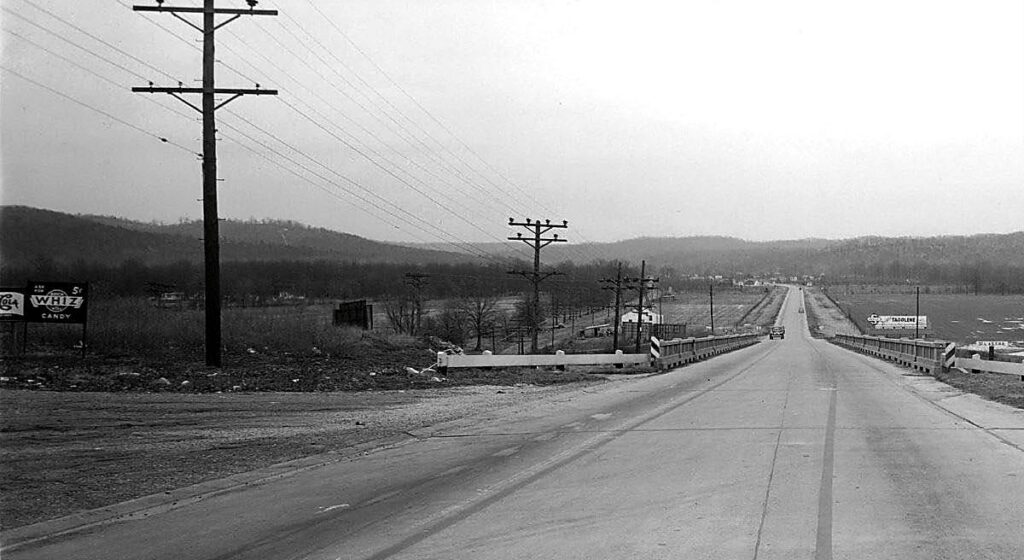
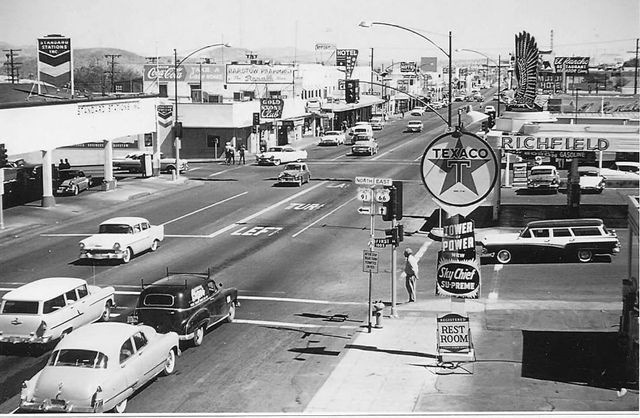
The Mother Road meant mother’s milk for gas stations and repair shops, cabins and motels, cafes and diners, as well as kitschy souvenir shops and trading posts that flanked the highway with faux tepees, cavalry forts and the occasional penned buffalo to attract travelers’ trade. They kept cars gassed and folks fed, bedded, and stockpiled with curios.
Ironically, the traffic that boomed business outgrew the roadway that buckled from the weight of America’s burgeoning population and their vehicles that increased exponentially. Higher speeds and safety concerns required four-lane divided highways. The emerging Interstate system bypassed 66’s doomed businesses like the vacuum whoosh of a Freightliner barreling down the expressway.
Speaking for those on the other side of history, Leon and Ann Little of Hinton Oklahoma put it succinctly when the Interstate by-passed them: “The day the traffic moved, well that was it.” Many businesses went from full house to poor house.
The crowd cheered when Bobby Troup cut the ribbon that both symbolized the opening of a new stretch of interstate and the end of Route 66 as a part of our national highway system. Troup admonished the throng: “I don’t why you’re cheering; this is an end of an era.” When the crowd dispersed, they left behind a ghost highway, a memory mirage floating above the old road as seen from afar.
The Interstate and a Road Less Traveled.
“For everything you gain, you lose something.” Emerson
Engineers designed Interstate highways to accommodate higher speeds and ever-increasing traffic. The open road shrinks as metropolises and ever-expanding lanes of highway traffic extend out to the hinterlands supplanting farmland and forests with a suburban sprawl of chain stores flanked by colossal billboards perched atop 50-foot monopoles. Cars and seismic semis race at 80 MPH in a competitive race to the next stack of vehicles that mocks the idea of the open road. The Interstate serves solely as means to an end where maintaining speed and position remain paramount.
Commentator Charles Kuralt once remarked: “Thanks to the interstate highway system, it is now possible to travel across the country from coast to coast without seeing anything.” No wonder some seek escape from the commercial stream consciousness via old Route 66.
Adventurous roadsters seek something new via something old. They do not want to make time, but to take time. The ultimate destination remains an afterthought. They exit the Interstate for an escape via a slowdown two-lane pathway that hastens senses that view small towns and farms, wooded hills and open range, mountains and deserts discovered along the way.
Eighty-five percent of old Route 66 remains extant. Navigation required. Disjointed in parts, some sections were incorporated into the Interstate itself. Old road fragments parallel the interstate as emasculated service roads while other segments pull away from the bypassing Interstate and link visitors to old town centers.
The Mother Road’s apparition takes form during many long jaunts that provide enjoyable two-lane traverses out of sight and sound of the super slab expressway. Those runs into the countryside differ from the interstate’s construct that scoured the land with broad swaths of concrete and uniformity needed to accommodate speed and traffic. Conversely, Route 66’s corridor follows the terrain’s contours rather bulldozing straight through it. Driving the old road feels more in tune with the land rather than zooming through it.
Two-lane sections of Route 66’s that find open spaces provide a decompression tonic, billboards and national chain stores conspicuous by their absence. A road uninterrupted by commercial call and competitive traffic infuses the road trip with a sense of serenity in a way that no Interstate ever could.
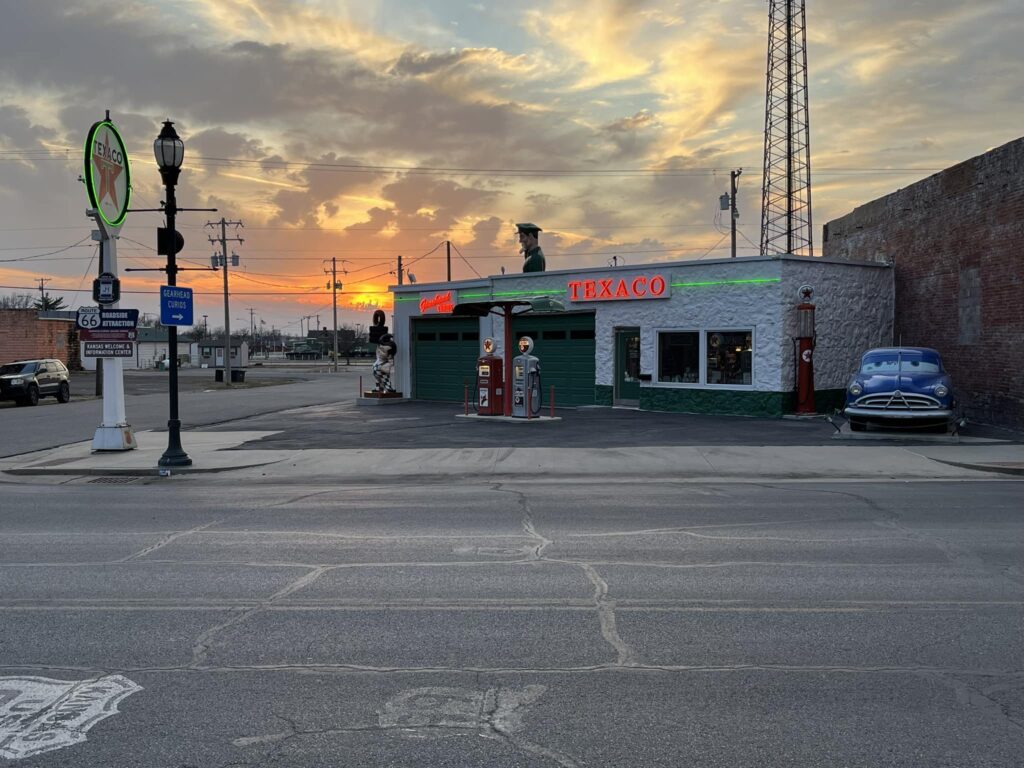
Travelers venture out on the Mother Road to imbibe history, slow reel our diverse geography, lodge in retro roadside motels, cross steel truss bridges, view vintage era gas stations, dally in towns to nosh in diners, observe the ruins of abandoned businesses, and eyeball the curios and the curious discovered along the way. The road less traveled offers a true taste of Americana seen along a motorway that bears the renowned double six.
A marker at the entrance of the Santa Monica pier on the Pacific Ocean reads: “Santa Monica—66—the end of the trail.” But Route 66 never ends in the imagination of American roadsters. The Mother Road continues her journey through time and mind, providing a unique way to experience the historic, cultural and geographic wonders of America the Beautiful.
The Interstate
our destined fate
with frenzied pace
to destined place.
Its mile wide swath
what’s there to watch
billboards and chains
vendors’ domain.
Homogeneous
monotonous
what has been seen
what does it mean?
So time was saved
as we all raved
but something lost
what was the cost?
Our lives speed by
blink of an eye
want to slow down
Sixty-Six bound.
6 replies on “Why Roadsters Still Traverse Route 66”
A wonderfully evocative essay Mr. Lore – vividly exploring both the pleasures and cultural significance of The Mother Road.
Kudos!
A wonderfully evocative essay Mr. Lore – vividly exploring both the pleasures and cultural significance of The Mother Road.
Kudos!
Another enjoyable and informative article! Alice and I read it while Linda was fighting traffic on the ever congested Interstate 80 stretch in northern Indiana.
So very nicely done, Paul. I am still impressed by your craft.
you got off easy on the short version
you got off easy via the short version.